Lenses
Clear comes in the box. A tint is ten dollars. Photochromic is twenty. Your prescription starts at twenty-five.
This is the decision the rest of the page hangs on, so it goes first.
Sunglasses have one setting. You put them on outside and take them off at the door, and because of that a sunglass lens can be as dark as the sun demands. Razzhood Glasses have a Bluetooth headset in them, which breaks that pattern in two specific places.
Indoors, you cannot take them off. You may be on a call. You may be halfway through something you are listening to. Pulling the glasses off ends it, and having to choose between hearing and seeing is a bad thing to make somebody do at a doorway. So the lens has to be liveable under a ceiling light, and a dark lens is not.
Outdoors, you still have to read your phone. Syncing, checking a transcript, searching for what you said on Tuesday — all of it happens outside, in the sun, on a screen. A dark lens sends the glasses up onto your forehead every single time. A pale one shades your eyes and leaves the screen alone.
In strong sun a pale tint does more than the number suggests: it takes the edge off to the point where you stop thinking about it, which is what you actually want from sunglasses you are not going to remove.
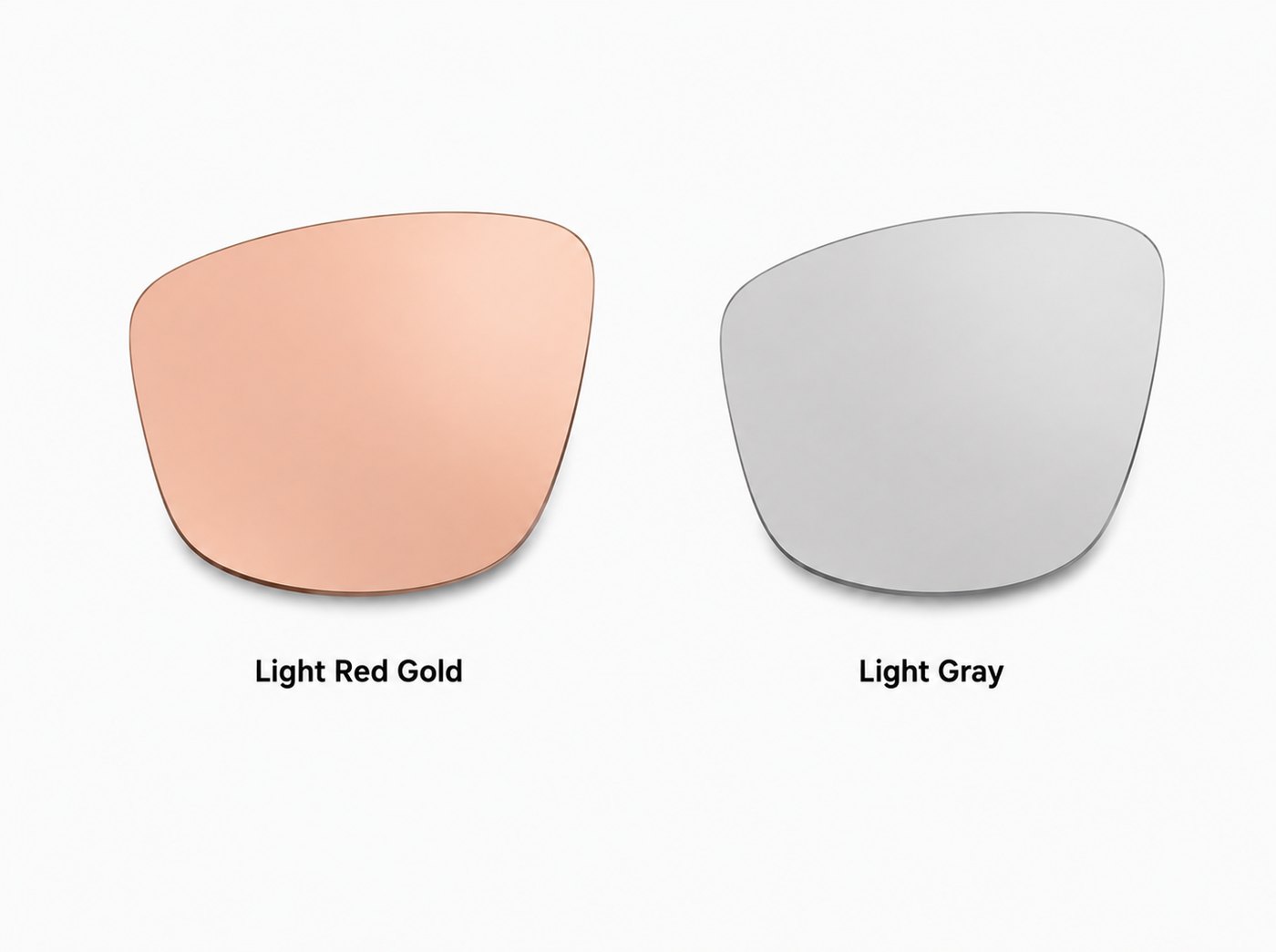
Two tints · $10

The interesting one. It is warm, young and current rather than conservative, and it lifts contrast in flat light — overcast mornings, dusk, tree cover.
The reason we chose it is less obvious. In testing, a very pale warm tint makes the whites of your eyes read whiter and your gaze read clearer. That effect is not for you. You will not see it in a mirror; it is what the person across the table sees. A lens colour that improves how your eyes read to other people is doing more work than one that only looks good on a shelf.
The safe one, and there is nothing wrong with that. Neutral, so it takes brightness down without shifting colour. Unisex, goes with anything, never the loudest thing in a photograph. If you want a decision you will not think about again, this is it.
Saturated colour is where eyewear starts looking cheap. True blue, true green, true yellow, bright white — every one of them is one bad light away from reading as plastic, no matter what it actually cost. Pale colours do not have that failure mode, which is why all four colours in this product, frames included, sit at the light end.
Photochromic · $20

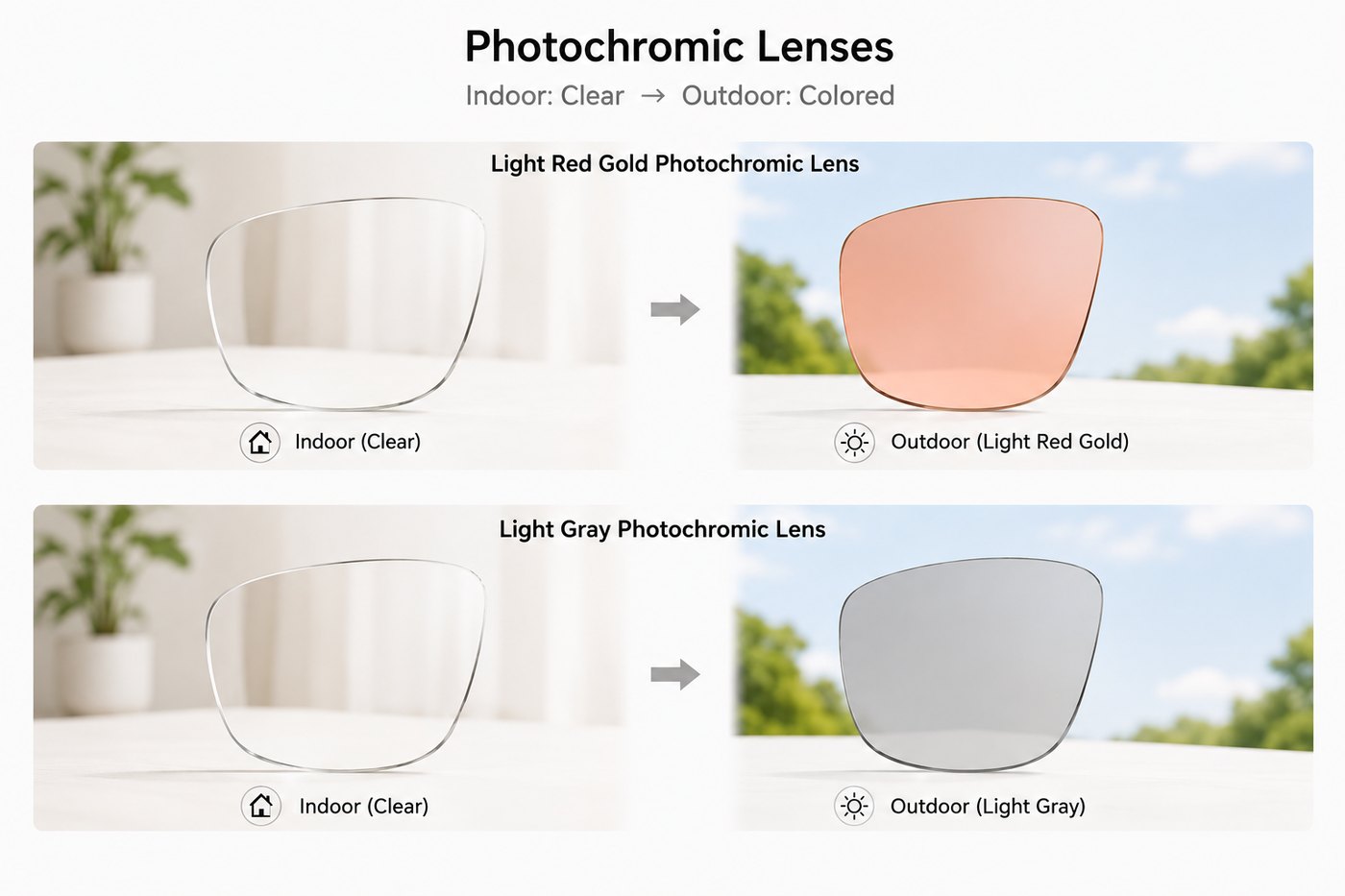
Available in both tints. Photochromic lenses contain molecules that change shape when ultraviolet strikes them; the changed shape absorbs visible light, so the lens darkens. Take the ultraviolet away and they relax back and it clears. Nothing is powered and nothing is switched — this half of the product has no battery at all.
It is the complete answer to the doorway problem. You keep the whole product on through a threshold instead of choosing between shade and hearing, and you never push the frame onto your forehead — which matters here more than on ordinary sunglasses, because moving the frame moves the main microphone away from your mouth.
We asked a lot of fashion creators about gradient lenses and the answers were consistent and blunt: a gradient reads middle-aged. It is a permanent stripe of darkness sitting on your face in every photograph.
Photochromic is the version of the same idea that does not carry that. Most of the time it is a clear lens. When there is sun, it is a pair of sunglasses. Nothing about it is permanent, which is exactly why it reads differently.
Photochromics react to ultraviolet, not to brightness. Two consequences are worth knowing before you spend the twenty dollars:
They also do not become perfectly clear indoors — expect a faint residual tint. Given how pale both tints are to begin with, this is a smaller gap here than it would be on a dark lens.
Prescription · from $25
Sunglasses get worn when the sun is out. Prescription glasses get worn every waking hour. That difference is roughly a factor of ten in wearing time, and it is the difference between a gadget you remember to bring and a piece of hardware that is simply on your face when the thought arrives.
Send your prescription after you order. Twenty-five dollars is the starting price for single vision; a strong correction needs a higher-index material and is quoted from your numbers rather than guessed at here. We confirm the final figure before anything is cut.
We do not fit progressives into this frame, and shipping a lens we know will disappoint is not a business we want to be in.
Why not polarised
A polarised lens filters light that has been reflected off a flat surface at a particular angle — water, wet tarmac, a car bonnet. That is genuinely useful for fishing and driving, and it is why polarisation is sold as the premium option almost everywhere.
It is also why it is wrong here. Phone and laptop screens emit polarised light. Put a polarised lens in front of one and it dims; rotate your head and at some angles it goes black. Every sync, every transcript, every time you check what the glasses caught, the lens is working against you.
Polarisation is a feature for looking at water. This is a product for looking at your phone.
A UV400 tint blocks the same ultraviolet, costs about half as much to produce, and leaves the screen alone. We would rather put that saving into the microphone housing, where you can hear the difference.
The dangerous myth
Ultraviolet protection has nothing to do with how dark a lens looks. It comes from the UV400 coating or from the lens material. Darkness is a comfort feature; protection is a chemistry feature; they are independent of each other.
Which produces a genuinely harmful failure case. A dark lens with no ultraviolet protection is worse than wearing nothing: the darkness makes your pupil open wider, and a wider pupil lets more ultraviolet reach the back of your eye than an unshaded, constricted one would.
That is what a cheap pair from a market stall usually is. It looks like protection and it is doing the opposite, and there is no way to see the difference by holding it up to the light.
Every Razzhood lens is UV400 — the clear one that comes free in the box, both tints, both photochromic options, and any prescription lens we cut. There is no version of this product where eye protection is the upgrade.
Pricing
| Lens | Added per pair | Notes |
|---|---|---|
| Clear UV400 | Included | Fitted to every pair unless you choose otherwise |
| Light Red Gold | $10 | UV400, never polarised |
| Light Gray | $10 | UV400, never polarised |
| Photochromic, either tint | $20 | Reacts to ultraviolet, not brightness |
| Prescription | from $25 | Quoted from your correction; any lens above |
Two frame colours times five lens choices is ten combinations, with prescription available on all of them — and because the bundle is two pairs, most people take a clear pair and a tinted pair rather than agonising over which. The picker on the front page configures each pair separately.
Care
The most common way a lens gets scratched is being wiped clean while it still has dust on it, which grinds the dust across the coating. Rinse with cool water first, then dry with the cloth. Skip alcohol and household glass cleaner; they strip coatings.
The other habit worth breaking: leaving them on a car dashboard. Heat softens TR90 and warps the fit, and warping the fit moves the main microphone away from your mouth — the one distance this entire product depends on.
The microphone ports are small openings with mesh behind them. If a recording ever sounds muffled, look at the port under the left rim before you look at anything else. Rinse it, do not poke it.
Lens questions
Yes. The electronics live in the temples, so a spare front lens set costs what the lens costs. Own a fixed tint and a photochromic pair and swap them by season.
They are polycarbonate, the standard impact-resistant material for sports eyewear. The frame is TR90 nylon, which flexes rather than snapping.
Yes, electrically — but do not do it. The main microphone port and its wiring channel are moulded into the front frame, and an unsupported rim flexes. The lens is a structural part.
All four combinations work, which is a consequence of everything being pale. Light Red Gold on Space Gray is the least expected of the four and the one most people in the studio ended up wearing.
Not at launch. The clear UV400 lens is a plain clear lens. We would rather ship four honest options than five, one of which is contested.
Yes, and it will not void anything. Take the frame in and tell them it is a TR90 front in ordinary indoor proportions. Ask them not to force the rim while the temples are attached.